The picture management tool Picasa (download: picasa.google.com) is simple and fast and therefore very popular by the general public of at home photographers. Even a beginner is quickly familiar with Picasa because this tool orders the digital collection of pictures at ease. And a fast computer is not needed at all... This tool has some simple features as well, like enhancing, printing and sending pictures. The user interface looks good, is simple and easy to understand. Although Picasa is suitable for the general public, it is not a picture management tool for professional usage.
An efficient file system for pictures
Managing digital pictures is a hard job, especially when there are thousands of
pictures. For this reason, it is wise to store the files systematically to keep
the database easy to browse. By placing each picture in a folder named after the
date of the picture (YYYYMM or YYYYMMDD), the folders will be ordered by the
date of the pictures. By adding additional information to the folder name (like "20080629
holiday X"), they are easily recognized as well.
A linear time scale is not sufficient
However, the overview gets lost when pictures of a certain subject are spread
over multiple dates. The pictures of different subject will be messed up by
following the ordering by date. There is a solution for this problem as well, by
creating subject folders and to split this folder up in multiple folders with
the dates as folder name. This way of acting is time consuming and mostly
impracticable. For this purpose, a picture management tool like Picasa can be
used.
|
|
At the installation of Picasa, the user is asked what folders to add to the indexation of pictures. You have to choose between the whole hard disk or the specific Windows folder for personal pictures (in most cased the folder with personal pictures will do fine). When the new pictures are found, you can see the thumbnails quickly go by. This indexation gives an indication how quick Picasa is in showing and managing pictures. Even the scrolling through all pictures is very fast as well!
ATTENTION: The indexation of pictures consumes a lot of hard disk space (XP: C:\Documents and Settings\loginname\Local Settings\Application Data\Google\Picasa2\db3, Vista: C:\Users\loginname\AppData\Local\Google\Picasa2\db3)!
Changing the name and location of a picture
In Picasa, pictures are easily renamed and the location of pictures is easily
changed by drag-and-drop as well. However, the original files are not moved
without asking the user. Multiple file names of pictures are changed all
together easily by selecting them and to select Picture, Batch edit, Rename.
All files will receive the same name and a unique number.
Importing pictures
The importing of pictures is done by the button Import.
Picasa imports the pictures automatically from the given location (camera or
folder). Be careful not to delete the original pictures after importing them.
Have a look at the feature Tools, Folder Manager
as well. This feature lets you select which folders to include and exclude from
importing.
Eventually you will get some problems when the folder structure of the Windows Explorer is used because some pictures could be categorized in multiple groups… Picasa has some solutions for this issue: by grouping specific pictures in a separate album without changing the original storage location! The albums can be created by using stars and/or labels (to categorize based on theme's).
Adding a star to a picture
The folder names are used for the classification of the database. This can be
quite annoying for a slide show, because a slide show is limited to a single
folder. To create a slide show from the best pictures, a star can be added to
each picture. The search option (View,
Search Options) quickly shows all pictures with a star.
Adding a label/tags to a picture
Stars can be used to create only one collection. To create multiple categories (e.g.
kids, pats, holiday,...), then the use of labels/tags is more efficient. By
adding multiple tags to a picture, it can be grouped in multiple categories. By
using the search option (View, Search Options) quickly shows all
pictures of a certain category.
Creating an album
Thanks to the stars and lables/tags it becomes easy to create an album of a
certain subject. By adding pictures to an album the pictures stay in their original folder.
By right clicking a picture and to select Add to Album, a picture
is added to a specific album (select New Album
to create a new album). This operation is more efficient when multiple pictures
are selected at once (use the
SHIFT key to select pictures next to each other, use the
CTRL key for spread pictures). The albums (with the added pictures) are
available in the left pain. By adding the best pictures into an album, to
prevent a long slide show with all similar pictures while all original are still
available on the original location.
TIP: Right click a picture in Picasa and select Properties for extensive technical information concerning the stored picture (used camera, the use of flash, focal length, exposure time, ...). This information is useful to determine why pictures are of low quality to prevent the same error from happening in future.
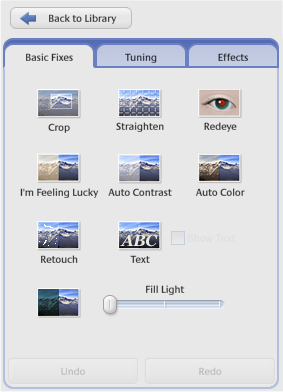
Enhancing pictures is easy within Picasa. For example, think of removing red eyes, straightening, cropping, color enhancements, contrast, ... These basic fixes to a picture are direct available after a picture has been selected.
The button Undo is very important as well, to roll back the changes made to a picture. The button Back To Library returns Picasa to the overview of pictures.
These picture enhancements are not really added to the original pictures, they stay untouched! The changes are saved in a file with the name Picasa.ini stored in the same folder as the original pictures. To view these hidden files activate the option Show hidden files and folders in the Windows Explorer by Tools, Folder Options, tab View.
TIP: After removing Picasa, the remaining Picasa.ini can be found (and deleted...) easily with the Windows search feature.
The integration of other software makes Picasa user friendly. Pictures are send by e-mail easily (again: use the CTRL key to select files!). The file size of the pictures to be send is optimized for the limited bandwidth of the receivers internet connection.

Burning pictures on a CD or DVD
Burning the pictures on CD/DVD for backup purposes is done by Tools, Backup pictures.
In the menu bar at the top of the window has the button
Gift CD as well to burn pictures directly on CD/DVD.
Creating a web album with favorite pictures
Sharing pictures with family and friends is done easily by creating a web album
(button
Web Album). The optimized thumbnails are created automatically. Combined
with the
HTML files they form a mini website with easy to browse pictures. The
created pages can be edited manually and uploaded (published) with a FTP program
on a webpage made available by the internet provider. By mailing the URL of the
website, family and friends are able to view the pictures of the online picture album.
Creating a screensaver of the favorite pictures
Creating a screensaver of the favorite pictures was never that easy. After the
pictures for the screensaver have been selected, select
Create,
Add to screensaver: and the screensaver is ready!
Creating a collage of the favorite pictures
Creating a collage of the favorite pictures is done by Create, Picture Collage.
Geotagging
By
Tools,
Geotag
pictures can be placed on Google Earth (to make this
feature work, Google Earth must be installed).
Creating a movie of the favorite pictures
A nice feature is to create a movie of your favorite pictures. Select the
pictures and select Create, Movie. Use compression (like XviD) to prevent
creating large movie files.
Other features
The button Order Prints is used to order online professional prints of
your favorite pictures. The exporting of pictures where the format and file
size can be changed is a nice feature as well. The pictures are ready for a
quick upload to a Blogger account as well.
No internet connection at the moment of ordering prints?
Does clicking the
button Order Prints result into an error message (no internet connection,
while there is...)? This is solved in the
Internet Explorer by Tools,
Internet Options, tab Advanced, button Reset. This resets
the Internet Explorer
settings, homepage included.
© 2001-2022 - Menno Schoone - SchoonePC - Rotterdam - The Netherlands